Python Functions
Functions are a fundamental concept in Python and other programming languages. They allow you to encapsulate a block of code, give it a name, and reuse it whenever needed. In short, a function is a block of code that performs a specific task.
Suppose, you need to create a program to create a circle and color it. You can create two functions to solve this problem:
- Create a circle function
- Create a color function
Dividing a complex problem into smaller chunks makes our program easy to understand and reuse.
What are functions?
A function in Python is a named block of code that can be executed when called. Functions are essential for making code more modular, readable, and maintainable. They can take input arguments, perform tasks, and return values.
Here’s the basic structure of a Python function:
def function_name(argument1, argument2, …):
# Function code here
return result
def: This keyword is used to define a function.
function_name: Replace this with the name you want to give to your function.
argument1, argument2, …: These are placeholders for input data that your function can accept.
return: This keyword indicates the value that the function can return.
Cases of Functions
-
A simple function
Let’s start with a simple example. We’ll create a function that adds two numbers and returns the result.
def add_numbers(a, b):
result = a + b
return result
You can call this function by providing two arguments, like so:
sum_result = add_numbers(5, 3)
print(“The sum is:”, sum_result)
-
Function without return
Functions don’t always have to return a value. Consider this function that prints a greeting message:
def greet(name):
print(f”Hello, {name}!”)
greet(“Alice”)
greet(“Bob”)
The greet function doesn’t return a value; instead, it prints a message. You can call this function with different names to print greetings for various individuals.
-
Function with default arguments
You can also provide default values for function arguments. In this example, we’ll create a function that calculates the area of a rectangle and assume a default width if not provided.
def rectangle_area(length, width=5):
area = length * width
return area
You can call this function with just the length, and it will use the default width:
area = rectangle_area(10)
print(“Rectangle area:”, area)
-
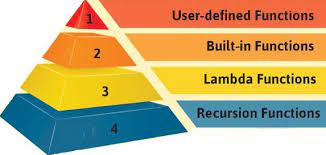
Recursive function
Recursive functions are functions that call themselves. One classic example is calculating the factorial of a number. Here’s a recursive function for calculating factorials:
def factorial(n):
if n == 0:
return 1
else:
return n * factorial(n – 1)
You can use this function to calculate the factorial of a number like this:
result = factorial(5)
print(“Factorial of 5 is:”, result)
-
Function with variable number of arguments
Sometimes, you might need to pass a variable number of arguments to a function. Python allows this with the *args syntax. Here’s an example of a function that calculates the sum of an arbitrary number of values:
def calculate_sum(*args):
result = sum(args)
return result
You can call this function with any number of arguments:
total = calculate_sum(1, 2, 3, 4, 5)
print(“Total sum:”, total)
Types of function
-
Built in function
The functions which come along with Python itself are called a built-in function or predefined function. Some of Python’s built-in functions are print(), int(), len(), sum(), etc. These functions are always available, as they are loaded into the computer’s memory as soon as you start the Python interpreter.
Example:
Python range() function generates the immutable sequence of numbers starting from the given start integer to the stop integer.
for i in range(1, 10):
print(i, end=’ ‘)
# Output 1 2 3 4 5 6 7 8 9
-
User defined function
Functions which are created by programmers explicitly according to the requirement are called a user-defined function.
Conclusion
Python functions are a crucial part of the language, enabling code reuse and abstraction. They allow you to break your code into manageable, reusable parts, making your code more efficient and easier to understand. With the examples provided in this blog post, you should have a good foundation for creating and using functions in Python. Practice and experimentation will further solidify your understanding and ability to harness the power of functions in your Python projects.